














Stock drifts between shops
You sell the same goods on four domains and each keeps its own count. The result: you sell something that is already gone.
Orders, stock, packing, carriers, claims, finance and automations on the same data. No retyping between shops, spreadsheets and carrier portals.
No card required. We connect your first shop with you.
Carriers
Not a plug-in for your shop but an operations layer above it. The order arrives, the system processes it, packs it, ships it, watches the delivery and, when needed, handles the claim and the refund.
Real screens from the system, not illustrations. The data in the screenshots is sample data — names and orders are made up, the system is real.
Item checks while packing and label printing in one place — a mistake is caught at the desk, not at the customer.
Modules →Add MitoOps to your phone home screen as an app — no app store needed. A notification says an order is ready to pack, the picker taps straight through to packing, prints the label, and the automation takes the rest. You choose what you want to be told about.
Modules →One view for all your shops — status, carrier and tracking number without switching accounts and portals.
Modules →A product register with variants, EAN and HS codes and minimum levels. A sale on one domain lowers availability on the others. Bulk editing changes HS codes, prices or sales on hundreds of products at once — with a preview and one-click undo.
Modules →
Every case has a status, a deadline and a step history. The module is live in production and available by plan; claims statistics can be read by your program over the API or by AI over MCP.
Modules →A rule editor of the form "when this happens, do that" over orders and shipments, with ready-made templates for common cases.
Modules →Analytics assembles units sold, costs, margin and a reorder proposal across markets straight from operations. AI purchase planning draws on your own supplier register; the monthly report generates itself as a spreadsheet, document or PDF.
Modules →
It answers questions about your orders, stock and documents — and helps organise the work along the way: drafting an e-mail, finding a document, writing up a summary. It ships with predefined skills for Google Workspace and Drive, so it can work with the mail, calendar, sheets and files you already have.
Modules →It summarises unread mail, drafts a reply straight into Gmail, proposes answers to reviews and writes your revenue into a new Google Sheet. It never sends an e-mail on its own and never publishes a review reply until you confirm it.
Modules →Answers customers on your website from the shop's public content — never from orders or personal data.
Modules →No developer and no migration project. Your shop stays where it is — MitoOps connects to it.
Shoptet via an access key, WooCommerce with a single click inside your own shop. Several shops and several markets at once.
Catalogue with variants, product feed, sitemap, orders and invoices. New orders then arrive live over a webhook.
Automations, e-mail templates and statuses come ready. Dispatch, the chatbot and the rules work the moment you turn them on.
We walk the first connection through with you. Typical time to the first printed label: one afternoon.
On the left, what an online shop is used to when assembling a system from several tools. On the right, what you get in one.
| Feature | Usual setup |

|
|---|---|---|
| Users on the entry plan | The second and every further user is normally an add-on | Five users on the entry plan |
| Carriers | One to three on the entry plan; the rest cost extra | Every connected carrier from day one, at no extra cost |
| Delivery outside the EU | Not offered, or only with a paid customs add-on | DHL Express on your own account number, electronic customs paperwork, Incoterms and a readiness check before the parcel is packed |
| Claims and returns | A separate paid service with no access to shop data | The case is created from the order with its items and prices — return shipment included |
| Refunds | The credit note is issued separately in accounting | The refund is prepared from the case and matched with the bank |
| Automation | None, or another tool with its own subscription | Rules over orders, stock and shipments inside the system |
| Several shops and currencies | Each shop its own account and its own stock | One stock and one order list across markets |
| AI over your own data | A chatbot on public content that cannot see operations | The assistant answers from orders, stock and finances; it writes only after you confirm |
We compare ourselves with a usual set of tools, not with a named product. Every row on the right can be shown in the application.
You sell the same goods on four domains and each keeps its own count. The result: you sell something that is already gone.
Packeta, GLS, DHL — every carrier its own portal, its own login and its own way of printing a label.
The case status is "somewhere in the mail". Nobody knows what is happening with it until the customer writes a second time.
End of month means downloading exports and gluing them together in a spreadsheet. Every month again.
How it runs
It connects to your shop through the interface you already have. Orders arrive instantly, stock stays reconciled, labels print from one place, and rules take over whatever repeats.
You paste your shop access key. MitoOps pulls in products, orders and invoices, and keeps them current through webhooks from then on.
You pick carriers, warehouses and markets, then set rules for what should happen on its own — for example "once packed, mark the order as shipped".
The team works in one interface. Whoever should see finances sees finances; whoever packs sees packing. The rest runs in the background.
They use the same orders, products, customers, shipments and permissions. That is why an automation can react to a tracking event, the chatbot can verify an order safely, and the internal assistant works on real company data.
You do not have to buy everything at once. Pick a goal and we will show a set-up that covers it.
One account, one true stock level across shops. Orders, products and movements in one place instead of four admin panels.
Packing with item verification, labels for every carrier from one screen, and statuses that switch themselves.
Rules of the form “when this happens, do that” over orders and shipments. No developer, and a history of every run.
A claim as a managed case with a deadline and an owner. A chatbot that verifies the order before it says anything about it.
Reconciled stock across markets, affiliate on real orders, and reports that are not assembled from exports.
The system is built as modules, but you do not pay per module. Every plan includes the whole list; plans differ by volume — shops, orders and emails.
Orders from every shop in one place, kept current by webhooks.
Product records, code registry and the history of every movement.
Packing with scanning, labels and tracking for multiple carriers from one place.
The same goods across several shops share one count.
A case with status, deadlines and full communication history.
Rules of the form "when this happens, do that" over orders and shipments.
An assistant over your own data, a website chatbot and a copywriter.
Monthly and custom reports from real data, not manual exports.
One place where a product is edited for every market.
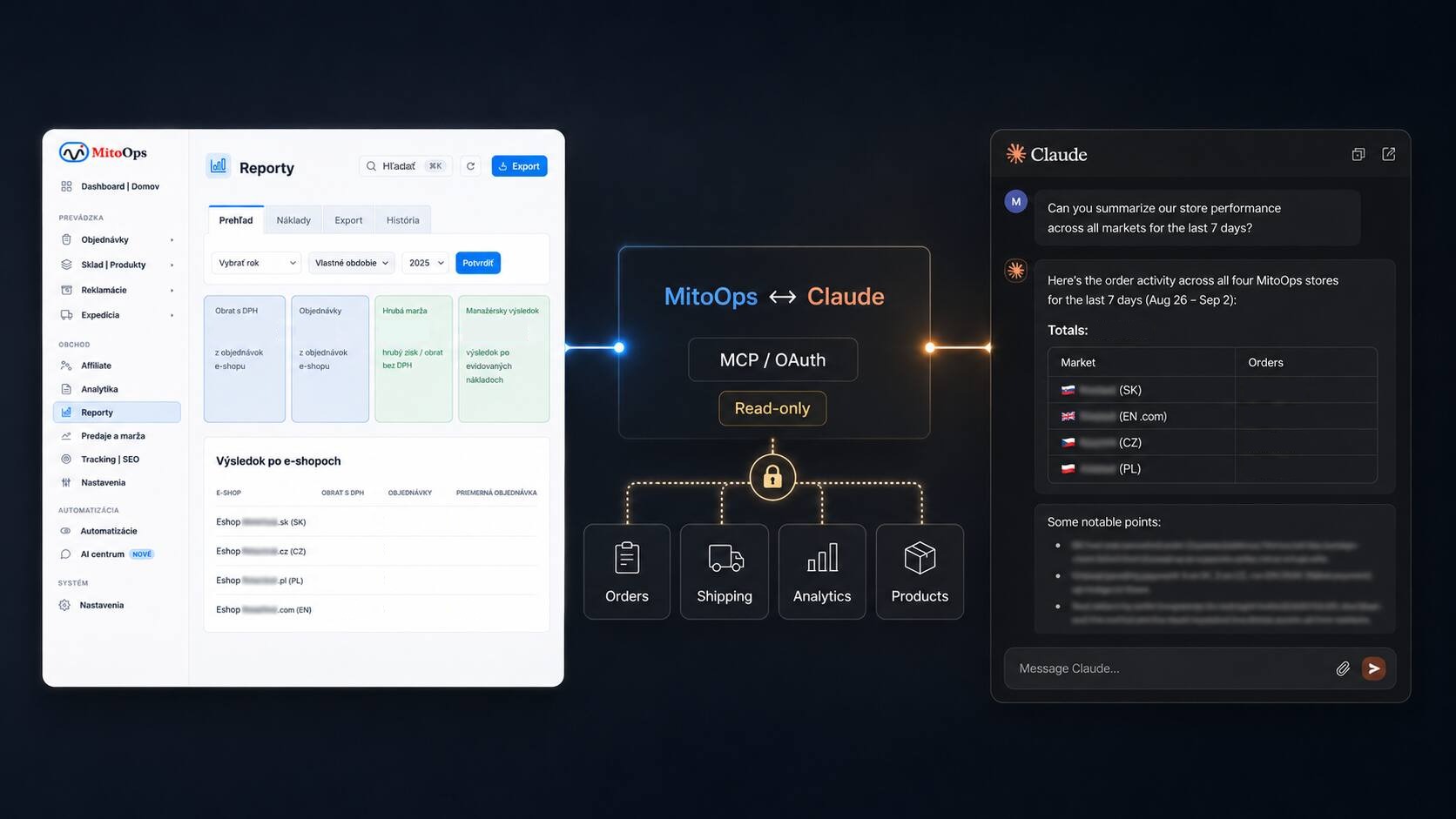
MitoOps joins your stores, stock, shipping and reports into one normalised layer. The same layer is open to your program over a REST API (read-only) and to an AI assistant over MCP, which reads and, with explicit consent, proposes a disabled automation draft — you are the one who enables it —, creates a discount coupon from the parameters you give it, and manages the affiliate programme (partner accounts, texts, campaigns; commissions and payouts stay with you). You choose the permissions yourself.
An estimate for a shop doing roughly 500 orders a month. We can run the numbers for your case on a call.
a month on shipping
Bulk label printing and automatic status changes instead of working through each carrier portal.
a month on reports
The monthly report is built from real system data, not from exports glued together by hand.
caused by stock discrepancies
Stock stays reconciled across shops, so you do not sell what is already gone.
Saving 18 hours a month at €15 an hour is roughly €270 — more than the Growth plan costs (€159 a month). The rate is an assumption; plug in your own.
No card required. We connect your first shop with you.
E-commerce platforms, accounting, banking, work tools and AI in one connected flow. You do not move data between them by hand.
Where orders, products and stock come from. Several shops at once, each with its own market and currency.




Invoices and documents reach your accounting on their own — you only approve them.

Payments match orders from the statement, not by eye.


Your own key or ours — the AI modules run on whichever you pick.


Mail, documents and calendar where the system actually works with them.


You enable each connection separately and grant only the permissions it needs.
„We sell on four domains in four countries and stock was always the biggest problem — the same number in four places. MitoOps reconciled it and folded shipping into a single step. Returns stopped living in an inbox. We use the system daily in production."
 production deployment across SK / CZ / PL / international markets
The system handles your customers’ orders and their customers. Here is how that is arranged — without certification badges we do not hold.
Every client has their own database, not a row in a shared table. Isolation does not rest on a condition in a query that someone can forget to write.
Who sees financial data, who may change stock, and who may only read. Configurable per section, not just “admin and everyone else”.
Who changed what and when — including access by our support, which requires a reason, a time limit and your consent.
Tokens for shops and carriers are stored encrypted and the interface never returns them. They never reach logs or the knowledge base.
The chatbot on your site reveals order status only after verifying the email used for the purchase. Without it, it says nothing.
A daily database backup with history. Recoverability is verified, not assumed.
We do not claim certificates or standards compliance we have not formally obtained. When we do, they will be here — until then it would be a claim nobody could check.
If you run a Shoptet shop across more than one market, get in touch. Clients joining at this stage get hands-on onboarding and pricing that reflects it.
More questions? Write to us and we will get back to you. Write to us
We connect your first shop with you — 14 days free, no card required. And if you would rather talk first: twenty minutes, no commitment, and we say plainly what MitoOps handles and what it does not.