


How to keep stock straight when you sell across several shops
Selling the same goods on several domains and the counts drift apart? Why it happens, the three possible fixes, and what stock reconciliation looks like in practice.
Practical writing about running an online shop. No marketing filler — we write about what we deal with ourselves.
Selling the same goods on several domains and the counts drift apart? Why it happens, the three possible fixes, and what stock reconciliation looks like in practice.
Not everything that can be automated is worth automating. The four tasks that give the most for the least risk, and how to spot a task that is not ready yet.
Every carrier has its own portal, its own login and its own way of printing a label. What unified shipping looks like, what can genuinely be unified and what cannot.
AI in e-commerce has three uses that genuinely pay off and several that cost more than they return. How to tell them apart and how to work out the real cost.
An assistant connected to a company Google account summarises mail, drafts replies and writes numbers into a sheet. What it saves, where the limits are, what to ask.
Analytics reports fewer orders than your shop does. That is not a measurement fault — it is its limit. What you can learn instead, and why admitting the gap beats filling it in.
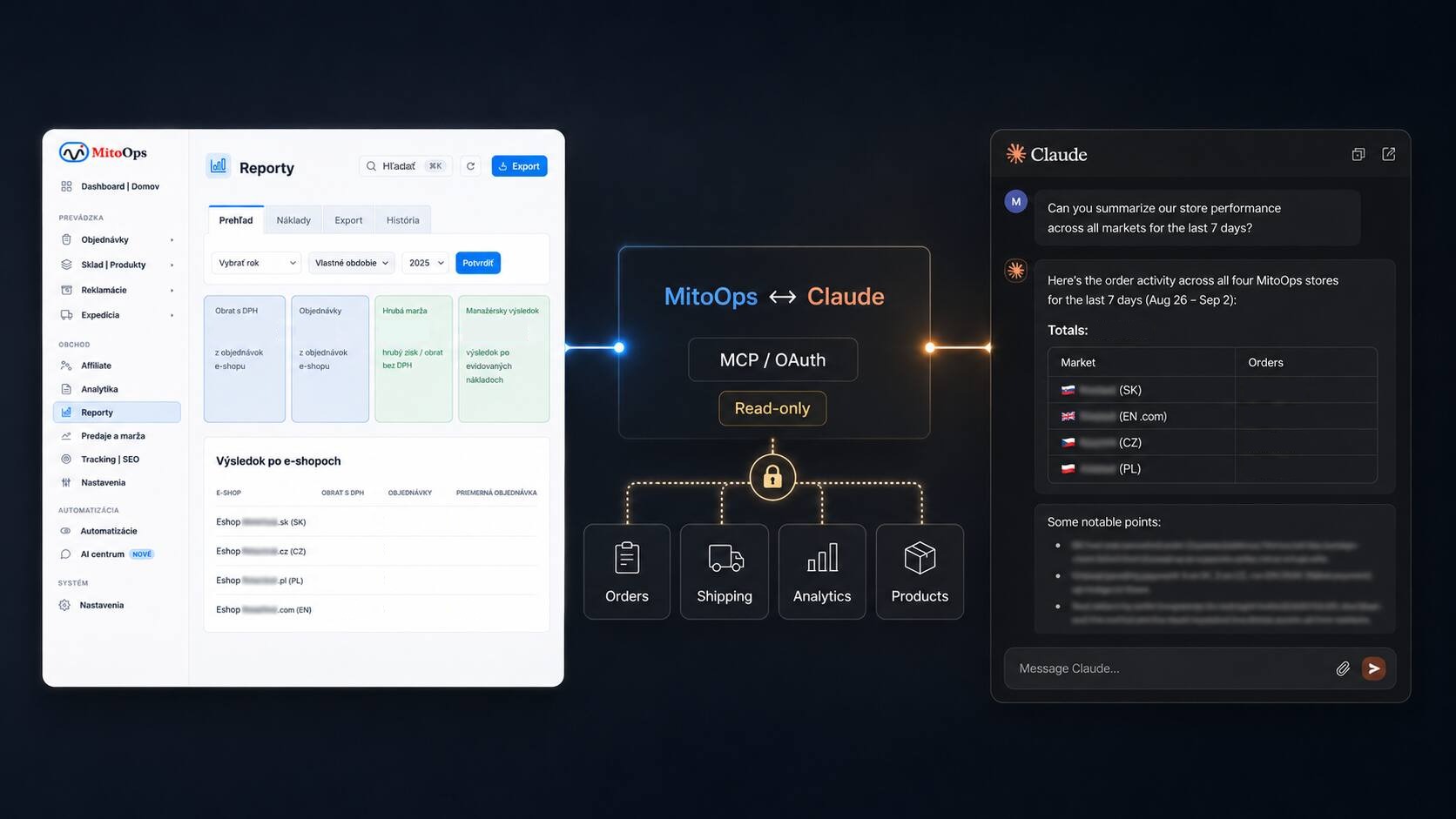
A case study from live operations: Claude.ai reads data from four stores through the MitoOps MCP server over OAuth. Orders, inventory, shipping, analytics, reports, suppliers, claims, the affiliate programme and automations — 84 tools across 20 scopes; the writes all require explicit consent: a disabled automation draft that a person enables, and a discount coupon — created from the parameters you give, updated or deleted only explicitly with a preview and confirmation; a coupon with a live dependency is never deleted.